
I had previously experimented with solar systems as a potential backup solution to stay online when the power was cutting out. After moving, I hadn’t used any of it. I was able to start setting up a few things to start charging the batter.
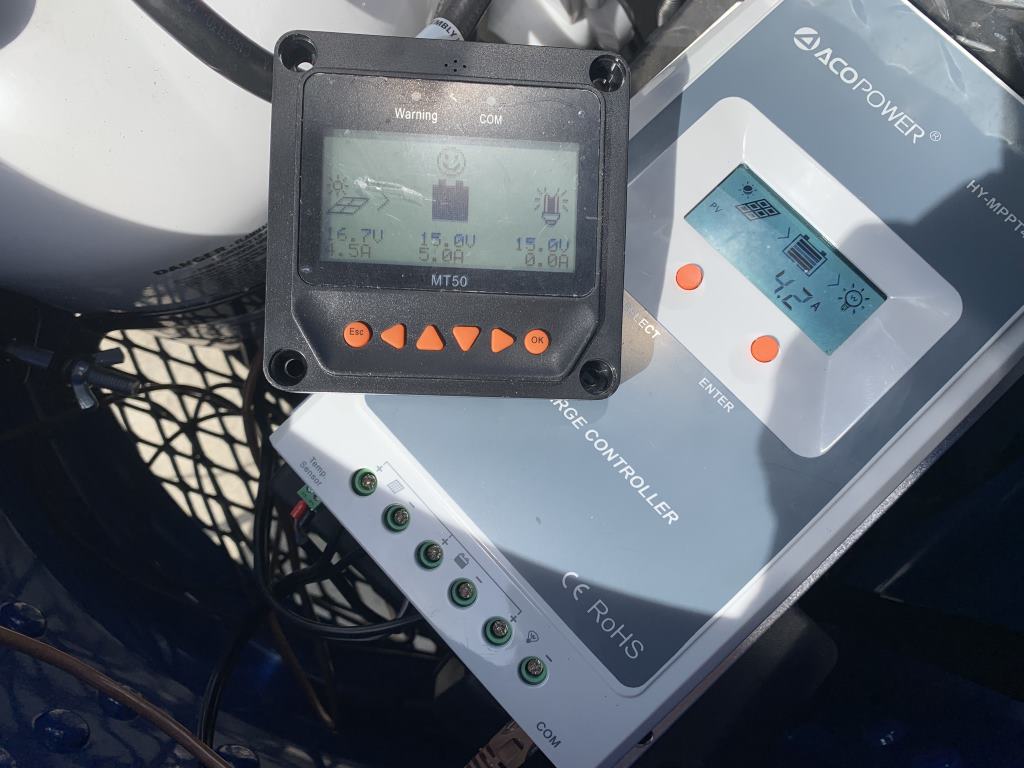
First, I have an AcoPower 40 Amp MPPT solar charge charger (model HY-MPPT40) . I added it first so that I could see the batteries state of charge. An MPPT charger constantly monitors both the battery voltage, battery temperature, and the power coming in from the array to determine whats the best voltage/amperage to apply to the battery. In addition, I have a separate AcoPower MT-50 Remote Meter LCD Display (model MT-50) that lets me monitor the information easier and adjust some of the settings. Last, I have a temperature sensor to monitor how warm the battery gets from the charge.
I got two Thunberbolt Magnum 100 watt solar panel kits from Harbor Freight (Item #65385). I often waited for them to go on sale for $100 with a coupon each time I picked one up. In order to hook up all eight panels, I’m using a Thunderbolt Magnum 400 Watt Universal Solar Connector (Item #68689).
The good news is that these amorphous silicon solar cells work in low-light conditions and are easy to pack up. The cons are that they take up a lot of space, and add weight.
One other item I have that I didn’t hook up is a Sunforce 1000-Watt Pure Sine Wave Inverter (model 11240-1). This lets me inverts DC power into A/C voltage. This may be enough to run a small 700 watt microwave. While running off of solar, you’ll want to avoid using A/C unless it’s necessary to prevent wasting energy inverting it.
I haven’t seen the amp hours on the battery just yet, but I can only assume it is 100 Ah on a 12v battery – but you can’t use all of those amps without destroying a lead acid battery. I have my eye on replacing the battery with a Lipo battery that can use all 100 Ah and weigh only a third of the current battery, and possibly wire a second up in parallel to pull more amps at once, and have power for a longer period of time.
The funny thing with batteries is that adding a second gives off the appearance that you are more than doubling the capacity you have available.
The last item on my list is to add my Raspberry Pi Solar Logger that connects to the charge controllers communication port.
 Lazy Express